

Best Sounding electric Guitars
 everyone desire perfect tone.
Some of us spend our life pursuing it. We scrutinize every note with painstaking detail, and now we look to our guitar heroes with godlike admiration. Usually, perfect tone is an upper-echelon objective we only dream of achieving.
Some say perfect tone is a mind-set. Indeed, confidence and control are key to great noise and strategy. But great tone becomes great tone with other little recommendations and adjustments. There may not be a one-size-fits-all formula for amazing tone, but there are a few helpful suggestions to keep in mind. Listed below are five.
1. Have actually a Well-Organized Pedal Board
Effects pedals are a terrific way to build your very own tonal identification. One standard thing to remember while turning your pedal board into the sonic playground is certain kinds of results seem most useful whenever placed in a specific purchase. While there’s no rigidly “right” option to organize your pedals, numerous frequency-shifting results can disrupt the alert road, discolor the tone or cause clipping when placed in specific sequences along with other types of results. Consider these basic tips whenever determining which results pedals go in which.
It's also advisable to understand whether any of your pedals function true-bypass changing, and exactly how that feature affects your sign. When an impact pedal with true bypass is off (in bypass mode), the sign moves directly through the pedal’s input to its production without driving through just about any inner circuitry, really acting like the pedal ended up beingn’t here in the first place.
True-bypass pedals are excellent for offsetting signal-chain sound and can maintain the integrity of initial tone. However, they could also reduce treble frequencies if you’re working with many results units and all sorts of the additional cable they might require (more info on cables in an instant). For those who have a larger pedal board with countless true-bypass effects, consider putting a buffered pedal somewhere in the effects string. It will make up for signal loss and improve high-frequency response.
2. Properly Intonate Your Tool
Climate modification, storage space as well as only daily use can throw your instrument regarding intonation. Ensuring that your electric guitar is correctly intonated is a simple way to keep its tone who is fit. If you are uncomfortable creating modifications to your instrument, have a professional service pro do so obtainable. In terms of some rough fundamentals on intonation, listed below are four useful steps:
- Very first, sound a note on 12th fret.
- After that play the 12th-fret harmonic of the same note by gently holding the string together with your fretting hand just over the actual 12th fret wire and sounding the note together with your picking hand.
- Compare the 2 pitches. If fretted note is flatter versus harmonic, go the string’s connection seat very a little ahead (toward the middle of the guitar) until the fretted and harmonic pitches match. If fretted note is sharper than the harmonic, move the connection seat really slightly right back (out of the center regarding the guitar) through to the fretted and harmonic pitches match.
- Perform per string.
3. Adjust the Pickup Level
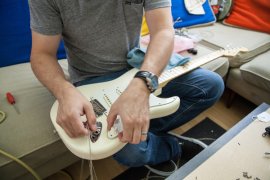
Pickups are an essential part of great tone. We can’t constantly alter their character without changing all of them completely completely, but adjusting their height is an excellent solution to fine-tune your guitar’s production amount efficiently. All of that’s needed may be the appropriate screwdriver, a ruler and some cautious experimentation.
In general, the larger the pickup, the more production it will create. It is possible to enhance your bass and treble levels depending on which side of the pickup you raise. Bear in mind though, that moving your pickups too near the strings can create nasty interference. Alternatively, decreasing pickups excessively can prevent all of them from properly sensing string vibration.
4. Understand Your Strings
Switching strings regularly is always a sensible way to maintain your tone sounding fresh. But switching the type of strings you use could be an actual and welcome online game changer. Many people don’t understand how easily they are able to test-drive a completely new noise at a rather minimal cost by simply switching the type of strings they use.
Share this article
Related Posts

Latest Posts


